


As more drivers switch to electric vehicles, businesses across the UK are being asked the same question: “Do you have EV charging?”
For many organisations, the answer is increasingly expected to be yes. But the path to offering EV charging is rarely the same for every site. Power availability, visitor behaviour, parking layout, and business objectives all influence what the right solution looks like.
This is why a single EV charging model rarely works everywhere. The most effective installations are the ones designed around how a site actually operates, not simply the technology available.
Different Businesses, Different Charging Needs
A retail park, a hotel resort and a workplace might all want EV charging, but the way drivers use those sites is completely different.
In a workplace setting, employees may park for six to eight hours at a time. Slower AC chargers can work well in this environment because vehicles have plenty of time to charge throughout the day.
At a roadside location or busy destination, however, drivers may only stay for 20–40 minutes. In these cases, rapid chargers are often the better solution, allowing vehicles to gain meaningful range quickly before continuing their journey.
Hotels and leisure destinations often fall somewhere in between. Overnight guests may need slower charging over several hours, while day visitors or golfers might benefit from faster top-ups during shorter stays.
Designing EV charging around these behaviours is what makes it useful - both for drivers and the business hosting it.
The Importance of Site-Specific Design
Beyond driver behaviour, every site has its own physical and electrical constraints. Power capacity, car park layout and existing infrastructure all influence what is possible. For example, a site with limited electrical capacity might need a phased installation that expands over time. Another location with strong grid access could support rapid charging hubs designed to serve drivers travelling longer distances.
Understanding these factors early ensures the solution is both technically viable and financially sensible. Rather than forcing a single model onto every location, the most effective EV charging projects begin with a detailed assessment of the site itself.
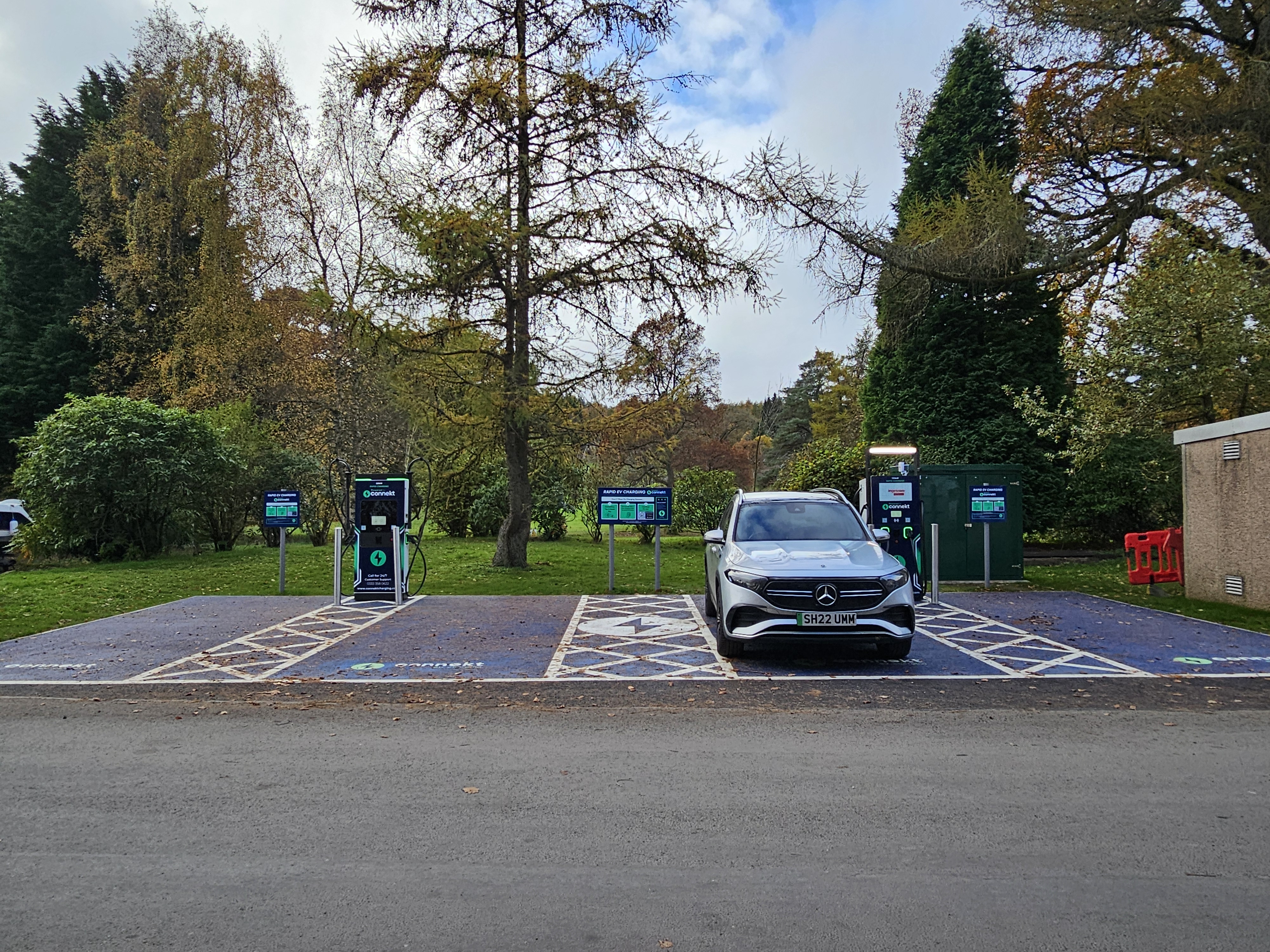
Real Examples of EV Charging Tailored to the Site
This site-specific approach can be seen across a range of Connekt installations throughout the UK.
At Cameron House on Loch Lomond, EV charging was designed to serve multiple types of visitors across the resort. Connekt installed 24 chargers across four strategic locations, supporting hotel guests, golfers and staff with infrastructure matched to their typical dwell times. More recently, the resort added a rapid charging hub featuring 60kW and 120kW chargers, allowing drivers at Cameron House to gain around 100 miles of range in roughly 25–35 minutes.
Meanwhile, within the holiday park sector, Connekt worked with Verdant Leisure to install EV charging across 12 parks, delivering a total of 26 chargers designed for guests who typically stay on site for several hours or overnight.
These examples highlight a simple truth: the right EV charging solution depends heavily on how a site is used.
.jpg)
Why Flexibility Matters
As EV adoption grows, businesses are increasingly aware that installing charging infrastructure is not just a technical project, it’s also a strategic decision.
Questions around funding, ownership and long-term operation often play just as important a role as the chargers themselves.
Some sites prefer fully funded solutions that minimise upfront investment. Others want partial ownership or the ability to generate revenue from charging. In certain cases, organisations may choose to invest directly in infrastructure to maintain full control.
The key point is that different sites require different financial and operational models, just as they require different types of chargers.
Charging That Fits Your Business
The most successful EV charging projects start with a simple principle: the infrastructure should adapt to the business, not the other way around. Whether the goal is improving customer experience, supporting staff, attracting EV drivers or preparing for future demand, the right solution will always depend on the specifics of the site.
That’s why a consultative approach - assessing how the location works before deciding what to install - consistently leads to better outcomes.
Speak to Connekt
If you’re considering EV charging but unsure what model would work for your site, the best place to start is a conversation.
Speak to Connekt to explore what type of EV charging solution fits your business, your site and your long-term goals.
Because when EV charging is designed properly, it doesn’t just work — it works for your business.
.png)
.png)
.png)
