
Going Green: Electric Vehicles See Surge in Popularity in the UK
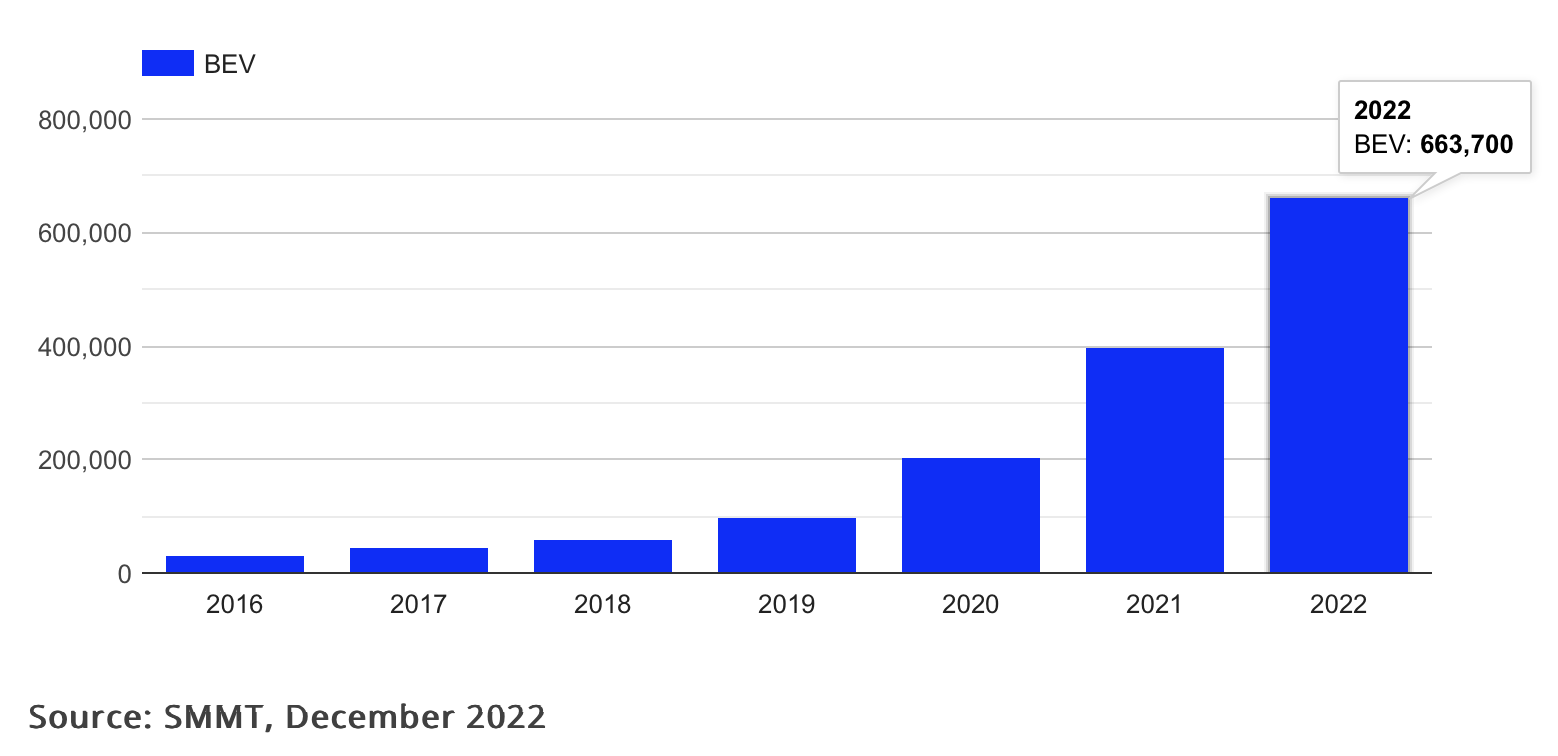
Electric vehicle (EV) uptake in the UK has seen a significant increase in the last 10 years, with a steady year-on-year growth in the number of EV registrations.
_KK0pJ.webp?dpl=dpl_DAY5JxtNA7bBtFu32YaH6vktLJ23)
Electric vehicle (EV) uptake in the UK has seen a significant increase in the last 10 years, with a steady year-on-year growth in the number of EV registrations.
However, it’s worth noting that the EV market in the UK has not been stable due to the changes in the government’s policies, and the overall market size was relatively small until recent years.
According to data from the Society of Motor Manufacturers and Traders (SMMT), in 2013, there were just 3,500 EV registrations in the UK, representing a mere 0.1% of the total market share. However, as of the end of December 2022 there were more than 660,000 battery-electric cars representing a 16.6% market share. More than 265,000 battery-electric cars were registered in 2022, a growth of 40% on 2021.
This trend is expected to continue, as the UK government has set a target for all new cars and vans to be effectively zero-emission by 2030, and for nearly every car and van on the road to be a zero-emission vehicle by 2050.
The introduction of affordable EV's
This growth in EV uptake has been driven by a number of factors, including the introduction of more affordable and practical EV models, as well as government incentives and funding for EV charging infrastructure. Car manufacturers such as Tesla, Nissan, and BMW have been leading the way in the UK EV market, with models such as the Tesla Model 3, the Nissan Leaf, and the BMW i3 proving to be popular choices among buyers.
In addition to these, many UK car manufacturers such as Jaguar, and Mercedes have also committed to producing electric vehicles and have invested in the EV charging infrastructure to support them. The government’s recent announcement of cutting the sale of petrol, diesel and hybrid cars by 2030 has also given an added boost to the EV market.
The growth in EV uptake in the UK over the last 10 years has been significant, and this trend is expected to continue in the coming years as more affordable and practical EV models become available, and as the UK government continues to support the transition to zero-emission vehicles.
Key EV Stats & Figures.
A typical electric car takes four hours to charge from 50% on a basic Chargepoint Scotland 7kW charger.
With a Connekt 22kw fast charger, a typical electric car takes 2 hours to charge from 50%, giving an average range of 180 miles.
Scotland has the highest number of EV charging devices per 100,000 population (47), followed by England (36), Wales (29) and Northern Ireland (17).
2022 was the best year for new electric car sales with 267,203 new EV registrations, an increase from 190,727 in 2021.
The Tesla Model S had the best maximum EV range in 2022, covering up to 379 miles on a single charge.
The Tesla Model Y was by far the best-selling electric car in the UK in 2022, with 35,551 sales.
(Source: DfT, SMMT, Gov.uk, Office for Low Emission Vehicles, Statista, Zap Map)
_2sAn3T.webp?dpl=dpl_DAY5JxtNA7bBtFu32YaH6vktLJ23)
_Z1Qoo9z.webp?dpl=dpl_DAY5JxtNA7bBtFu32YaH6vktLJ23)
_ZHTMYF.webp?dpl=dpl_DAY5JxtNA7bBtFu32YaH6vktLJ23)